Before You Renovate: What Every New Landed Homeowner Must Know
date
4 July 2026
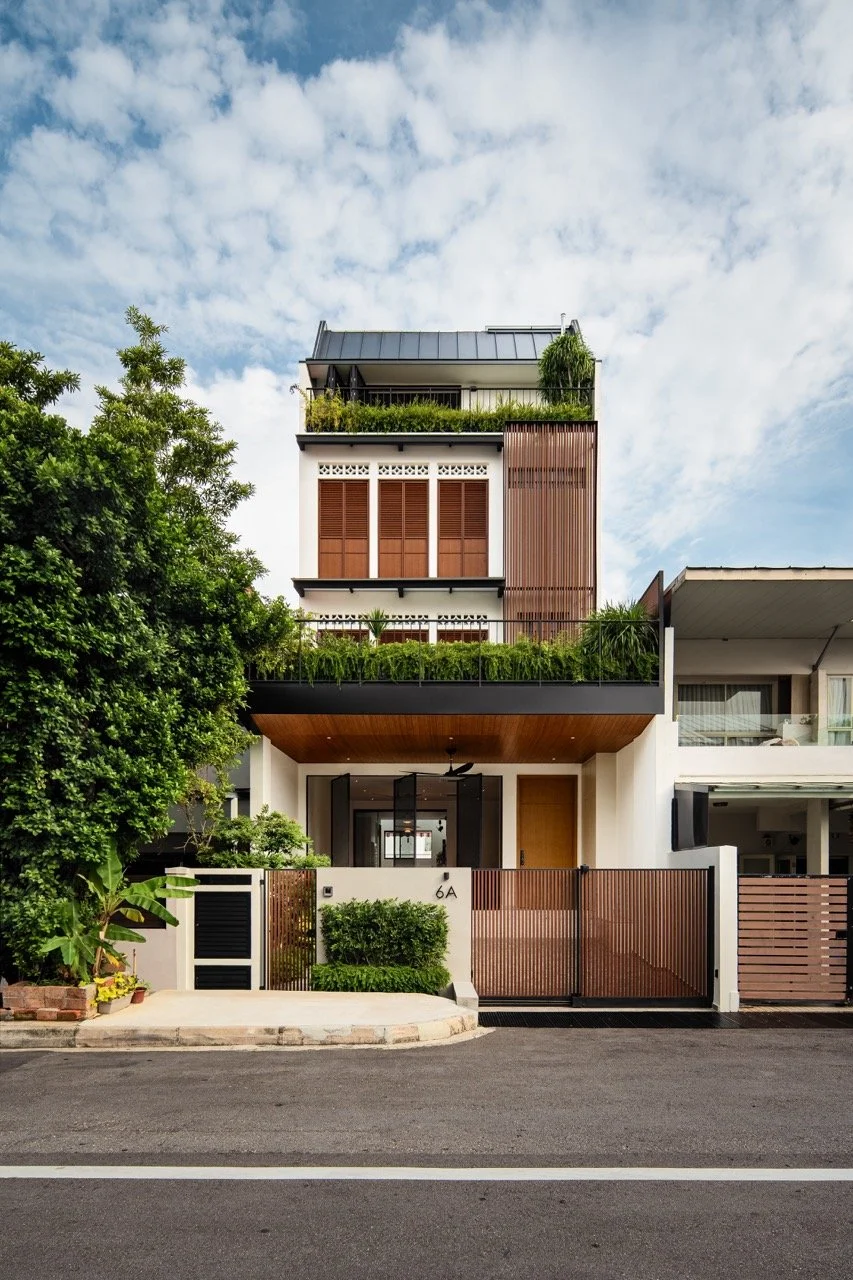
Before you start renovation, critical groundwork will determine what's possible on your land and what it costs. We've guided countless homeowners through this phase, and here’s what you should know before you embark on your home renovation.
The Permission Phase
You’ll need to understand your site before you design for it. This means engaging various specialists in sequence, to verify essential information required for any design work.
Start with the land.
Before anything else, commission a topographic survey. This establishes the exact coordinates of your plot boundary—essential for any submission to authorities and for designing accurately within your constraints. For renovation or extension work, a measured building survey plots the precise location of walls, ceilings, columns, and structural elements as they actually stand, not as original plans suggest.
A good surveyor costs between S$3,950 and S$6,500 depending on complexity. This is a non-negotiable cost. It's the foundation for everything downstream.
Understand what's beneath.
A soil investigation is necessary. Engineers need to know your site's bearing capacity before they can design foundations that won't fail. You can sometimes borrow an existing soil report from a neighbour within 30 metres if they've recently conducted one, with their explicit permission. Otherwise, commission your own.
Check for hidden hazards.
If your building was constructed before 1 January 1991, an asbestos survey is mandatory. A licensed surveyor will identify it; if present, a licensed removal contractor must handle disposal. Budget S$870–S$972 for the survey.
The Infrastructure Phase
Your site connects to public systems—drainage, sewerage, roads. Understanding these reveals what you can and cannot do.
Drainage Interpretation Plan (DIP) clarifies where public drains run near your property. It shows you the location and size of drainage reserves, the minimum platform level your finished floor must sit above to avoid flood risk. If a drainage reserve encroaches on your boundary, you'll need to identify any setback requirements and understand what land the State might eventually reclaim. This information shapes your useable footprint and costs.
Sewerage Information Plan (SIP) maps public sewers and pumping mains in your vicinity. If a sewer line crosses your property, there's an easement—PUB (Public Utilities Board) has the right to access and maintain that line. Easements can restrict your ability to build over them; PUB codes specify minimum setbacks from sewer lines. This directly affects your development density and plot ratio calculations.
Road Line Plan (RLP) shows if your property falls within a road reserve—land the Land Transport Authority safeguards for future road construction or widening. If it does, any building protrusions into that reserve must be removed before you develop. If you have no intention to develop, you needn't act immediately. But when you do, those encroachments will cost you.
These plans come from government agencies and cost little (typically included in your architect's submissions), but they're essential reading. They tell you the true constraints of your land.
The Structural Phase
Once you understand your site, engage the professionals who will design and oversee construction.
A Quantity Surveyor (QS) manages cost estimation from initial calculations through final accounts. They prepare preliminary costing before tender, allowing you to adjust your design for better value before committing to construction. They also bid and determine contractor pricing. For a landed house project, expect fees of S$20,000–S$40,000 depending on project size. This investment prevents cost surprises.
A Civil & Structural Engineer designs buildings to be safe, withstand environmental forces, and improve structural integrity of existing structures. On renovation work, they submit to local authorities (BCA permits for structural work, demolition permits, railing and staircase approvals). They produce structural drawings for tender and evaluate contractor submissions. A Resident Technical Officer (RTO) or Resident Engineer (RE) should oversee construction—budget S$3,000–S$5,000 for this supervision. Structural engineer fees typically run S$30,000–S$50,000 depending on complexity.
The architect manages the structural engineer on your behalf, coordinating submissions and ensuring your interests are protected.
A Mechanical & Electrical (M&E) Engineer designs lighting, electrical, plumbing, sanitary systems, and—for basements—pump and flood control systems. M&E fees range from S$20,000–S$50,000 depending on project scope and complexity. This isn't luxury; it's the systems that make your home liveable.
The Timeline
These phases happen sequentially, not simultaneously. Survey first. Then consult on infrastructure. Then engage your architect and engineers.
For tender projects—new construction or major renovation—plan 6–8 months from engagement to tender. For design and build projects, 5–6 months from engagement to construction start.
This isn't slow. It's the pace of doing things properly.
Why It Matters
A great home is built on good foundation. When you've done this groundwork, your architect and contractors have clarity on the parameters, and can bring your ideas to life.
Treehaus Architects supports homeowners through each phase—from initial site assessment through design to construction. We coordinate surveyors, engineers, and authorities on your behalf, translating technical requirements into possibilities for your space.
Spaces for your stories.